Why This Research Matters To Entrepreneurs
Your brain isn’t the enemy — but the way you think about yourself can make the difference between stopping and scaling.
I completed a PhD studying how identity structure, uncertainty tolerance and self-esteem influence wellbeing and performance. What this research shows is strikingly relevant for entrepreneurs — because the same psychological processes that affect everyday confidence also shape the decisions, actions and resilience needed to grow a business.
What the Research Found (Business Relevance)
My research identified three major psychological factors that predict how confidently you can show up, take risks, and persist in your entrepreneurial journey:
1) Tolerance of Uncertainty
Entrepreneurs constantly face unknowns — pricing, launches, hiring, marketing, growth pivots. When uncertainty feels threatening, decisions stall and momentum slows.
2) Self-Esteem
Your internal sense of worth directly influences pricing decisions, visibility, negotiation confidence, client interactions, and boundary setting.
3) Identity Clarity
When you know who you are — what you stand for, what you offer, and what you won’t compromise — your messaging, positioning and strategic choices become clearer and more effective.
Each of these play a decisive role in entrepreneurial action, not just personal wellbeing.
Why You Should Care
Traditional business training focuses on strategy without understanding how the entrepreneur thinks. My research bridges that gap — giving you tools that help your internal state translate into sustainable business decisions.
This isn’t self-help. It’s evidence-backed insight that helps you:
✔ stop second-guessing
✔ build steady internal confidence
✔ make high-stakes decisions with clarity
✔ take action even when outcomes aren’t certain
The Academic Stuff
Lindsey’s area of interest is identity and its impact on wellbeing and the ability to live a satisfying and successful life.
Having gained First Class Honours Degree in Psychology, Lindsey had studied the available research and believed that there was a gap in knowledge about when, and how, identity affected psychological wellbeing. Most research focuses on the content of self-concept, the beliefs that you have about yourself, and that’s important. But the structure of your self-concept – self-concept clarity – is also important, and there had been little modern research into the effects of that.
Lindsey was also interested in the reasons that people have a poorly defined self-concept. Childhood adversity – which includes trauma, neglect and a dysfunctional home life – is one suggested cause, because it disrupts the developing self-concept. Lindsey’s research investigated relationships between a difficult childhood, low self-concept clarity , low self-esteem, intolerance of uncertainty, and psychological wellbeing. She also looked at the impact of current stressors on the same factors, and investigated the use of memory to maintain a sense of self.
Research had also focused on clinical populations – people who met the criteria for a diagnosis of a mental health condition. But people who are not affected badly enough to get a diagnosis suffer the same distress and life disruption, are less likely to be financially successful, and are unable to get any sort of formal support. Also, subclinical symptoms can often get worse and develop into disorders. Lindsey takes a dimensional approach to mental health and believes that support should be available to improve the wellbeing and results of people who don’t meet the criteria for a mental health disorder. She wanted to research the impact of identity at subclinical levels, both to understand how distress could be reduced, and to provide data to support interventions which might stop symptoms developing into clinical level mental health problems.
Lindsey’s aim was to contribute to the field of psychology by increasing understanding of identity-related factors that can be incorporated into clinical interventions, and to underpin her own work where she supports people to improve their results and enjoy greater psychological wellbeing.
The main findings from her PhD research were:
Higher scores on measures of depression and anxiety were linked to lower expectation of goal achievement
Autobiographical memory may be used to restore a sense of the self, and restoring a sense of the self may reduce symptoms of anxiety and depression
Autobiographical memory may be used to construct a positive sense of self in hypomania (subclinical bipolar disorder), contributing to symptoms
A direct relationship between childhood adversity and symptoms of anxiety and depression
Self-concept clarity mediated the relationship between childhood adversity and symptoms of anxiety, depression and hypomania
Self-esteem mediated the relationship between childhood adversity and symptoms of anxiety and depression
Intolerance of uncertainty mediated the relationship between childhood adversity and anxiety
Self-concept clarity mediated the relationship between current stressors and hypomania
Self-esteem mediated the relationship between current stressors and depression and hypomania
Intolerance of uncertainty mediated the relationship between current stressors and hypomania
PhD Thesis
https://publications.aston.ac.uk/id/eprint/46814/
Published Papers
Sharratt, L. & Ridout, N. (2024). Direct and indirect effects of childhood adversity on psychopathology: Investigating parallel mediation via self-concept clarity, self-esteem and intolerance of uncertainty. British Journal of Clinical Psychology. https://bpspsychub.onlinelibrary.wiley.com/doi/10.1111/bjc.12523
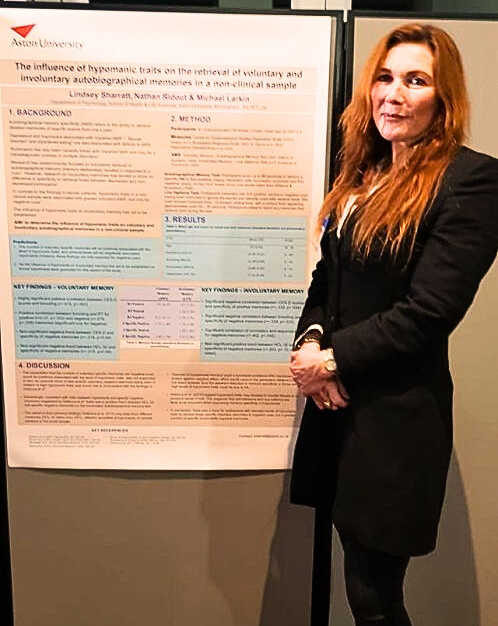
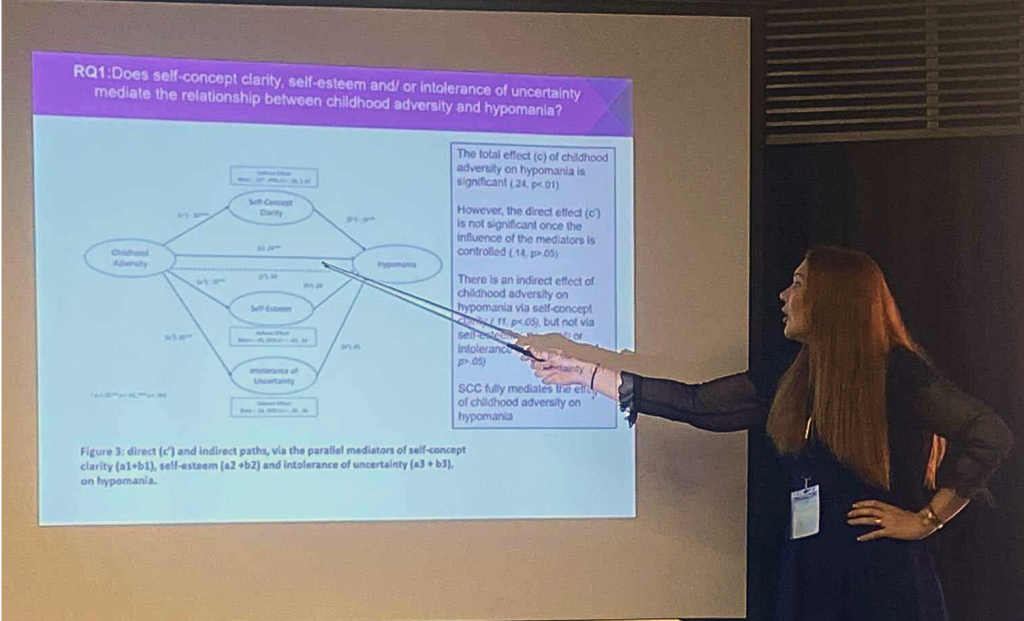

Conference on Autobiographical Memory and Psychopathology, University of Cambridge, UK 2019
Conference on Applied Research in Memory and Cognition, University of Nagoya, Japan 2023
PhD Graduation, Aston University, UK, 2024